
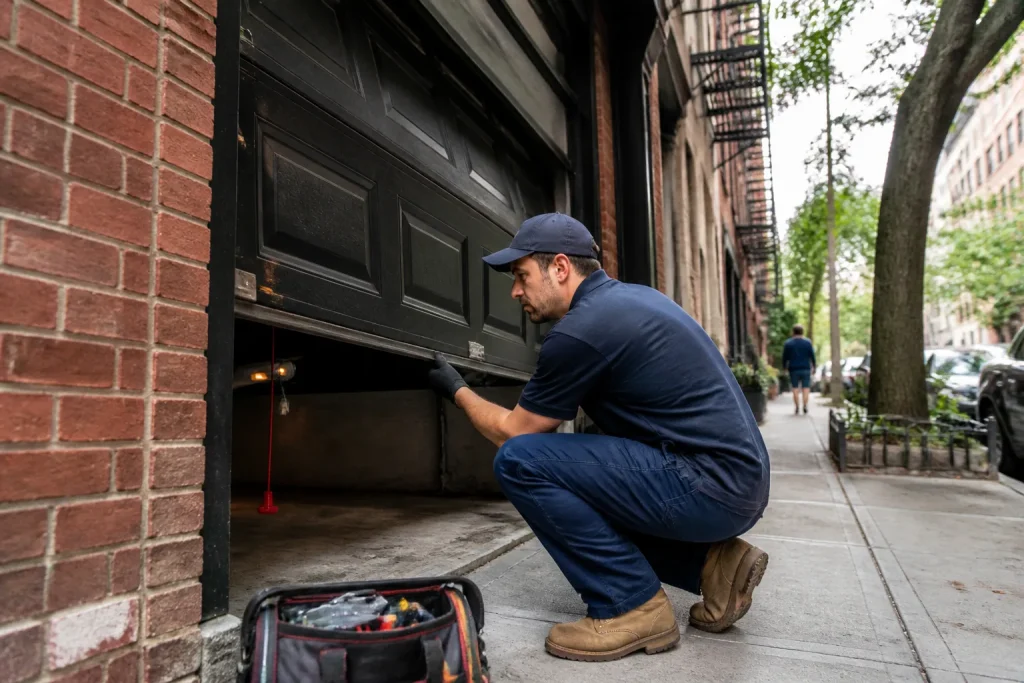
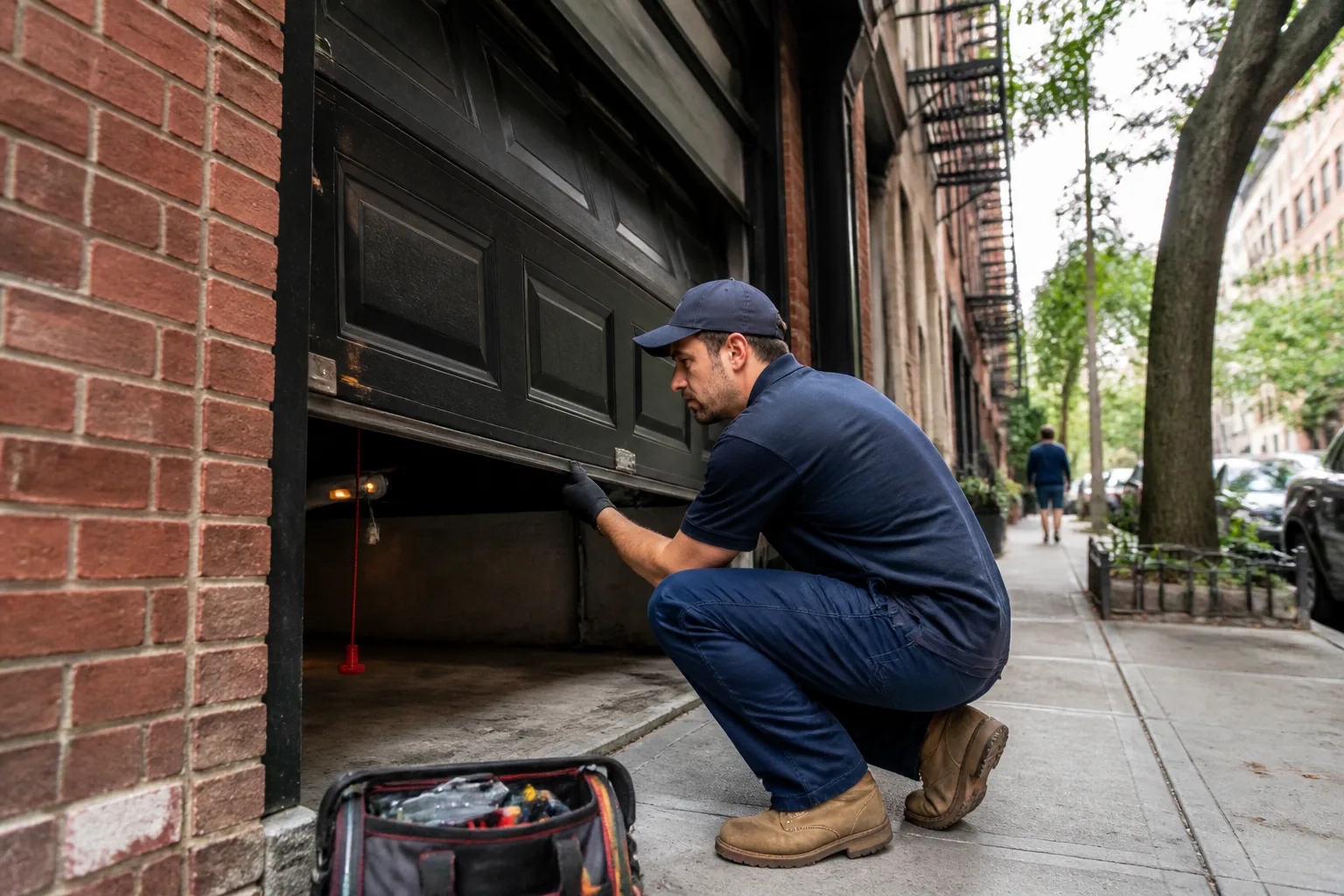
Emergency Garage Door Repair Near Me: What Greenwich Village Homeowners Should Do First
Pulling the red emergency release cord while a torsion spring is broken doesn’t free your door. It removes the only thing controlling a 200-pound panel that gravity would very much like to drop on whatever sits underneath it. Homeowners reach for that cord because it’s bright red and it looks like the answer, when in reality the right first move is to stop, step back, and read the door before touching it. Here’s the sequence we wish every Greenwich Village caller had run through before dialing.
If you’d rather hand it to someone who does this every week, call (844) 395-2808. We answer 24/7, and fast dispatch runs from 7am to 7pm, Sunday through Friday.
Which garage door failures are real emergencies?
A snapped torsion spring, a door that has jumped its track, and an opener that let go mid-cycle are true emergencies that need a trained technician. A remote that suddenly needs re-pairing, a blinking error light, or a door that closes most of the way and reverses can usually wait for the next scheduled visit. That single distinction decides who you call and how fast.
Here’s how we sort the two groups. Failures that go on the emergency list:
- Broken torsion spring. Usually a loud bang followed by a door that won’t lift, or lifts a few inches and crashes back down. The spring carries the door’s weight. Without it, the door is a falling object sitting on rails.
- Door off-track. One or more rollers have left the rail, so the door leans, binds, or hangs crooked. Running the opener here bends panels and can pull the whole track from the wall.
- Opener disconnected mid-cycle. The door is stranded partway up or down, the trolley has lost the carriage, or the arm has snapped loose. Nothing is holding anything in place, and you can’t trust the door to stay put.
- Any door left open and unattended. This is a security problem before it’s a mechanical one. Street-level garages in Greenwich Village sit a few feet from sidewalks, and an open bay is an open invitation.
Failures that can wait for a scheduled visit: a noisy opener that still lifts the door, a keypad or remote that quit pairing, a photo-eye that got knocked out of alignment, a cosmetic dented panel that still seals. If the door moves smoothly under its own power and stays where you leave it, you have time. If it drops, leans, or hangs, you don’t.
Why you should never try to lift a door with a broken spring
Because the spring does the lifting, a door with a broken spring can weigh 150 to 200 pounds or more, and every bit of that weight lands on you the moment you pull it up by hand. The “just lift it myself” instinct is mechanically wrong, and it’s how a broken spring turns into a crushed hand or a dropped door.
People picture a garage door as a light metal panel on smooth rollers. In practice, the torsion spring above the door is wound to counterbalance almost the entire load. With the spring broken, that counterbalance is gone. The door feels strangely light for the first few inches because the tracks angle back, then it becomes a dead weight and the spring’s stored energy is no longer helping you lower it in a controlled way.
The emergency release cord is the second trap. On a door with a broken spring, the red cord severs the opener from the door – and the opener was the only thing holding the panel up or down. Never pull that cord on a door with a suspected spring failure, a door that’s hanging off-track, or a door that’s stuck open with no tension in it. If you’ve already pulled it and the door is now free-falling or jammed, stop and get clear of the opening.
The springs themselves are worse. Wound torsion springs hold a violent amount of energy, and the winding process requires the right bars, the right technique, and a person who has done it many times. This is the repair we tell homeowners to leave alone no matter how handy they are, and it’s one of the reasons spring work stays with a trained technician rather than a general handyman. Many hardware stores won’t touch it either, because there’s no safe way to sell someone a loose torsion spring and a YouTube link.
What to tell us when you call, so the first visit finishes the job
Give us four details and the technician can arrive with the right parts instead of turning the call into a diagnostic-only visit: the door’s brand and rough size, what broke and when, the opener brand, and whether the door is currently stuck open or closed. That’s a two-minute conversation. It’s the difference between a repair and a second appointment to come back with the correct spring.
Here’s the list to have in your head:
- What failed and what it sounded like. A bang from above the door points to a spring. A grinding or scraping points to rollers, cables, or track. A door that moved partway and stopped points to the opener.
- The door brand, and the panel material. If you don’t know, the label or a manufacturer sticker is usually inside the panel or on the bottom bracket. Clopay and Amarr doors are common in the older walk-up buildings around Greenwich Village, and the panel gauge matters when we’re matching hardware.
- The opener brand. LiftMaster and Chamberlain are the two we see most in connected homes, and legacy Genie and Craftsman units hold on in plenty of prewar buildings. “Know your opener, know your door” isn’t a slogan – the troubleshooting path is brand-specific from the first step.
- Door state right now. Stuck open or stuck closed changes what we load and how we approach the repair.
- Access. More on this below, but tell us if the garage faces an alley, a shared courtyard, or a narrow carriage entrance.
If the problem turns out to be a smart-home opener losing comms rather than a mechanical failure, that’s a much quicker fix, and our garage door opener repair service covers both the myQ-style systems and the older units. We work on the brand you already have rather than steering you toward a replacement.
Getting a service van to your door in Greenwich Village
Greenwich Village access is its own problem, and it’s worth thirty seconds of your time on the phone. Many garages here sit off narrow lanes, behind shared courtyards, or under buildings where the only approach is a walkway too tight for a full-sized van. Knowing that up front lets us plan the arrival instead of circling the block while your door hangs open.
What we ask about:
- Alley-facing and courtyard-access garages. If the garage door opens onto a private lane or a shared courtyard, tell us how the technician gets in and whether there’s a gate code or a buzzer. A van can’t always pull up to the door, and the tech may need to carry tools a short distance.
- Street parking restrictions. Greenwich Village blocks change rules fast, and a spot that’s clear at noon may be a loading zone or a no-standing zone an hour later. If your building has a driveway apron or a side street with a workable curb, say so.
- Building access. A walk-up with an interior garage, a rear-access bay, or a garage shared with a neighboring business all change how the call runs. If we need a key, a fob, or a building contact to get to the door, we’ll ask.
- Time of day. If your block gets congested during certain hours, mention it. We’d rather plan around it than discover it on arrival.
This is also why a quick, accurate call beats a long one. Tell us the door brand if you know it, describe the access honestly, and the dispatch is more likely to land in one pass. If you’re not sure what you have, say that too – we’d rather spend an extra minute on the phone than a second trip to your block.
Securing the door while you wait
What you do while waiting depends entirely on whether the door is stuck open or stuck closed. Stuck open and your garage is exposed, so the priority is blocking the opening. Stuck closed and the door is probably holding its own weight, so the priority is making sure nobody tries to force it and that the opener stays off.
If the door is stuck open:
- Don’t force it down. A door that came off-track on the way up can come off completely on the way down.
- Block access to the opening. A vehicle parked in front works when you have one. A folding table or a couple of bins across the width does the job in a pinch.
- Unplug the opener if the panel is partway up and the trolley looks disconnected, so nobody hits the wall button or a remote by accident.
- Move anything valuable or weather-sensitive out of the garage bay if you can get to it safely.
If the door is stuck closed:
- Leave it down. A closed door sitting on its tracks under spring tension is usually stable.
- Unplug the opener so a stray remote press doesn’t try to run a jammed mechanism.
- Don’t pull the red release cord. It’s the single most common way a stuck-closed door becomes a stuck-open one.
- If you need to get a car out, we’d rather you call than improvise. There are safe ways to move a door, but they depend on what’s broken.
In a shared building, tell your neighbors the bay is out of service. A well-meaning neighbor pressing the wall button on a jammed door can turn a broken spring into bent panels.
When to call a pro
Call a technician the moment the door won’t hold its position, hangs off-track, or drops under its own weight. If a spring has snapped, the door is stuck open with no tension in it, or you’ve heard a cable let go, that’s a call now, not in the morning. On the other side of the line: a door that still moves smoothly and stays put can typically wait for a scheduled visit.
The failures above are the ones we handle as a core service rather than an upsell. If you’re weighing a repair against a full replacement because the panels are tired or the door never sealed properly, our garage door installation page covers what a new door involves. Most calls, though, are same-day problems with a straightforward fix, and our garage door repair team handles panels, springs, cables, and hardware in one visit. For the broader picture of what we cover across the neighborhood, see Garage Door Repair Greenwich Village.
The Bottom Line
The first fifteen minutes after a failure are where most damage happens, and it’s almost never because someone panicked. It’s because they did the logical thing – lifted the door, pulled the red cord, ran the opener – on a mechanism that punishes logic. Step back, decide whether it’s a true emergency or a morning problem, then make one call with the details ready. Our technicians have up to 12 years of experience, and we handle springs, panels, openers, cables, and hardware under one roof, so the person who diagnoses your door is the person who fixes it. The written estimate sets the final price, so you’ll know the number before any work starts.
If you’re in Greenwich Village and need help, Garage Door Repair Greenwich Village offers free estimates – call (844) 395-2808. We answer 24/7, with fast dispatch from 7am to 7pm, Sunday through Friday.
Frequently Asked Questions
Yes. A broken torsion spring is a true emergency because the door is no longer counterbalanced and can drop without warning. Keep clear of the opening, don’t pull the red release cord, and don’t run the opener. Call (844) 395-2808 – estimates are free.
No. A door with a broken spring can weigh 150 to 200 pounds or more, and lifting it by hand puts that full load on you with no controlled way to lower it. It’s the most common way a spring failure turns into an injury. Call a technician instead.
Tell them the door brand and rough size, what broke and when, the opener brand, and whether the door is stuck open or closed – plus how a van reaches your garage. That lets them bring the right spring and hardware on the first visit. Call (844) 395-2808 to get the details on record.
Most garage door calls are same-day problems, and we dispatch through Greenwich Village with fast dispatch from 7am to 7pm, Sunday through Friday. We answer 24/7. A call outside dispatch hours is booked into the next opening. Call (844) 395-2808 for an exact quote.
No. The written estimate you agree to before work starts sets the final price. We quote per job after seeing the door, spring size, and opener, and you approve that number before any repair begins. Call (844) 395-2808 – estimates are free.
Written by the team at Garage Door Repair Greenwich Village.
Need Garage Door Help?
Call Garage Door Repair Greenwich Village - the local pro we connect you with is licensed and insured, here with fast help in Greenwich Village.
(844) 395-2808